White Land Fee Exemption Cases under the New Regulations
The White Land Fees System imposes an annual fee not exceeding 10% of the value of undeveloped urban land owned by one or more individuals or legal entities, excluding state-owned properties.
However, the new executive regulations specify certain cases where the landowner may be exempt from paying these fees. In this article, Al Salamah Law Firm and Legal Consultancy explains the key exemption cases and how you can benefit from them.
Article content
What are the exemption cases under the White Land Fees System?
According to Article 8 of the new Executive Regulations:
- The application of the fee is suspended when any of the following criteria are met:
(a) If any of the conditions stated in Article (7) of the Regulations are not met.
(b) If there is a legal impediment that prevents the owner from disposing of the land during the statutory payment period provided that the owner is not the cause or a participant in creating the impediment.
(c) If there is an obstacle preventing the issuance of development or construction permits during the statutory payment period provided that the owner is not the cause or a participant in creating the obstacle.
(d) If the land is developed or constructed within the statutory payment period. - Without prejudice to the above, the fee may be suspended for a period determined by ministerial decision if the land development is completed within the timeline that does not conflict with the annual fee invoicing schedule in the city.
- An additional period may be granted by the committee (established under Article 3) for completing the development or construction of the land, depending on its size and nature. If development is not completed within this period, the due fees will be collected as per ministerial guidelines.
- If the suspension applies only to a portion of the land, the fee will still apply to the remaining undeveloped part.
Exemption Cases
1. Lack of Eligibility Conditions
Under Article (8), if any of the conditions in Article (7) are not met, the land is exempt. These conditions include:
- The land must be undeveloped (“white land”).
- It must be suitable for development or construction.
- It must fall within the boundaries specified in the official announcement.
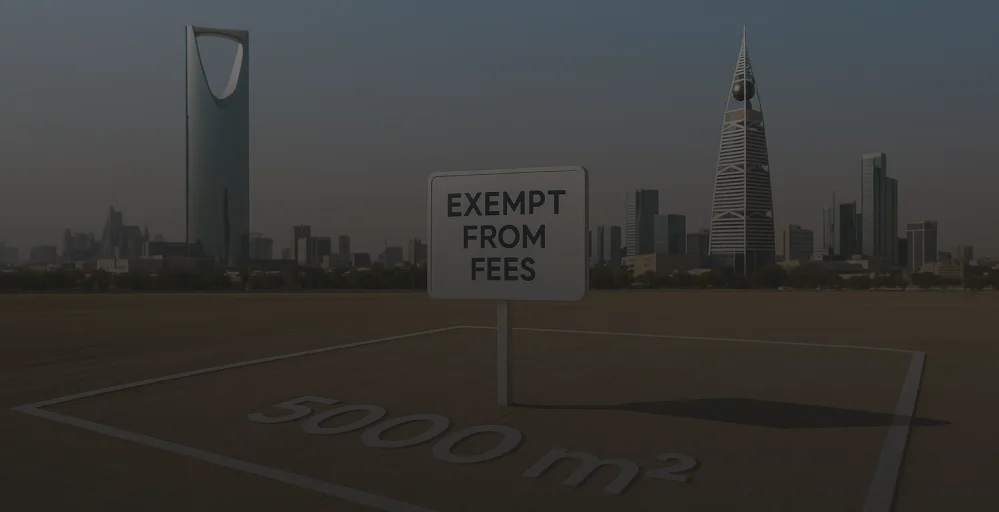
- The land area—or the total area owned by one person within the city—must not be less than 5,000 m².
Not all conditions must be met simultaneously; if even one condition is missing, the fee does not apply.
For example, if a land parcel is undeveloped, suitable for building, and located within the applicable zone but its area is only 2,000 m², it is exempt because the size is below the 5,000 m² threshold required for the fee to apply.
2. Existence of a Legal Impediment to Disposal
Certain situations legally prevent the owner from selling, developing, or otherwise disposing of the land, such as:
- Ownership Dispute: Ongoing court litigation over ownership.
- Judicial or Administrative Seizure: Court or government order freezing the property (e.g., for debt security or a criminal investigation).
- Co-ownership Dispute: When land is jointly owned and subject to a court case for division or sale, preventing independent action by a co-owner.
- Prohibition of Disposal: Any official order restricting the owner from disposing of the land.
- Judicial Liquidation: Lands under court-ordered liquidation may be exempt How Did a Landowner Legally Avoid a SAR 100,000 Fee?.
- Title or Boundary Conflicts: Officially recorded disputes preventing transfer or use.
- Natural Disasters: Flooding or landslides rendering the land unusable.
- Declared Hazard Zones: Land designated as dangerous (due to explosion risk, pollution, etc.).
- Expropriation Decision: Government decision to expropriate for public interest.
- Pending Expropriation Process: Administrative orders preventing transactions pending expropriation.
- Protected or Restricted Area: Land declared a nature reserve or heritage site.
- Urban Planning Freeze: Temporary prohibition of transactions in areas under future infrastructure plans.
- Mortgaged Land: Land pledged as security and cannot be sold before mortgage release.
Important Note:
In all the above cases, the exemption applies only if the owner is not the cause or contributor to the impediment.
3. Existence of an Obstacle Preventing Development
Some lands cannot be developed for legitimate reasons, such as:
- Planning Suspension: Municipality decision to freeze building permits in the area pending master plan review.
- Sudden Regulatory Changes: Unexpected amendments to construction codes (e.g., height limits, setbacks).
- Ongoing Government Projects: The land falls within an active public project (e.g., road, railway, or utility network).
- Service Suspension: Temporary suspension of essential utilities (water, electricity, sewage) by government order.
- Mandatory Environmental/Geological Studies: Required studies outside the owner’s control before licensing (e.g., unstable soil).
A notable example involves a landowner who avoided paying SAR 2 million in fees due to such an obstacle.
Additional examples include:
- Environmental Contamination: Pollution requiring official remediation.
- Discovery of Archaeological Sites: Halted construction pending excavation.
- Lack of Infrastructure: Absence of roads or public utilities due to state planning delays.
- Public Utility Failures: Regional network issues preventing service connection.
- Strategic or Security Restrictions: Temporary suspension of permits for national or environmental reasons.
Important Note:
Exemption applies only when the owner is not the cause or participant in the obstacle.
4. Completion of Land Development
Paragraph (d) of Article 8 provides that if the landowner develops or builds on the land within one year (the statutory period) from the date of fee invoice issuance, the land becomes exempt from the fee.
- If the invoice pertains to a previous year, the period starts from the date of issuance.
- Payment of the fee is due within 90 days from the date of official notification.
Definitions:
- “Construction” means erecting complete structures (excluding fencing) in accordance with approved building permits and requirements.
- “Development” means completing the full infrastructure works (utilities, roads, etc.) as per the approved master plan and permits.
FAQs
What is the minimum land size subject to the White Land Fee?
Lands with a total area of 5,000 m² or more.
What is the statutory period for paying the White Land Fee?
Within 90 days from the date of official notification.
What is the statutory period for developing or constructing the land?
One calendar year from the date of the invoice issuance.
What is meant by “developing or constructing” the land?
Construction: Building complete structures (excluding fencing).
Development: Completing the land’s infrastructure as per approved plans and permits.
Conclusion
Al Salamah Law Firm and Legal Consultancy provides full legal support and guidance to help you understand the new White Land and Vacant Property Fees System and its executive regulations.
If you wish to file a formal objection or inquire whether your land qualifies for an exemption, our team at Al Salamah Law Firm is ready to assist you.